WHITEPAPER · Part 5 of 13Full text
Chapter 2 · After Mental Availability: The Migration from Brand Availability to Model Weighting
Marketing in the Agent Era · Canlah AI · a Singapore SEO + GEO agency
✓You are reading the complete text — not a summary. All 13 chapters are published in full, free, no registration. The PDF is a print edition of the same content.
2.1 Borrowing a mature framework rather than coining a new term
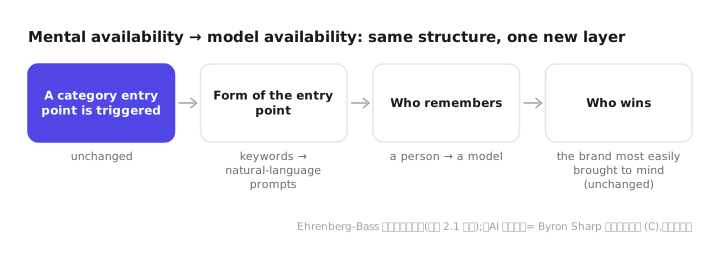
Byron Sharp and the Ehrenberg-Bass Institute’s theory of mental availability is among the most robustly tested brand theories of the past twenty years: purchase occurs when a category entry point is triggered, and the brand that wins is the one most easily brought to mind at that moment.
In an agentic environment this structure is not overturned. A layer of intermediation is inserted into it: the party doing the remembering shifts from a person to a model. Category entry points change form from keywords into natural-language prompts. We call this layer model availability.
This is not a new piece of marketing vocabulary. Byron Sharp himself has acknowledged in public commentary that “AI availability” could stand as a third form of availability alongside mental and physical availability (C — a comment on a social platform, not an academic publication; when quoted, its nature must be stated accurately and it must not be written up as an “Ehrenberg-Bass research finding”).
2.2 But the migration is not a straight transfer: incumbency inside a model is far more fragile
One important property of mental availability is inertia: it accumulates slowly and it decays slowly. Model availability does not appear to have that property.
A simulation study across three models in the skincare category provides the clearest evidence so far (A−, preprint, two authors, single-category simulation):
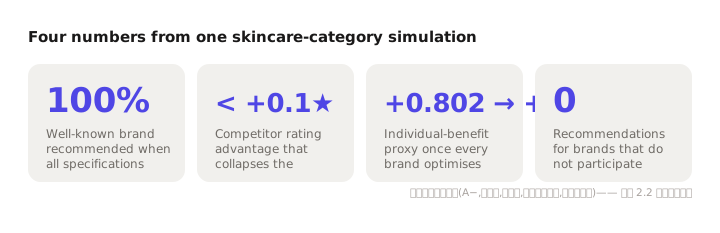
- When all brand specifications are held identical, the well-known brand is recommended 100% of the time. The brand prior is very strong.
- That monopoly collapses as soon as a competitor gains a rating advantage of less than +0.1 stars.
- When every brand adopts the same optimisation strategy, the individual-benefit proxy falls from +0.802 to +0.007.
- And brands that do not participate in the optimisation receive zero recommendations.
Taken together these four findings describe a competitive structure quite unlike traditional brand equity:
Incumbency is real, but it is conditional, and the condition is very easily overturned. A model’s preference for a well-known brand can be erased by a 0.1-star rating gap, and 0.1 stars is what a competitor can obtain from a single cycle of review operations.
The fourth finding matters most. When the whole industry optimises, the first mover’s excess return approaches zero, while the non-participant’s return is an absolute negative: zero recommendations. That is not a campaign proposition. It is renewal logic, not a land-grab: doing the work only holds your position; not doing it loses everything.
Any sales script that frames GEO as “seizing first-mover advantage and capturing an excess dividend” is inconsistent with this data. The honest formulation is: this is a defensive, continuously payable fixed cost, not a one-off arbitrage opportunity.
2.3 Three limitations
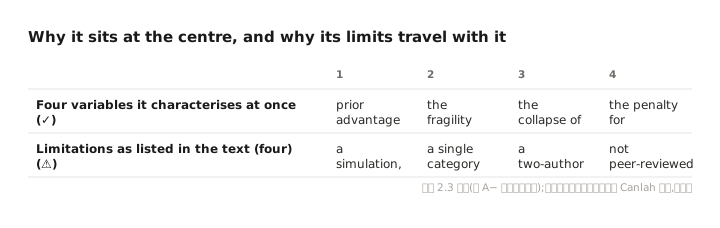
The limitations of this simulation must appear alongside the conclusion, or the conclusion is being misused: it is a simulation, not an observation of a real market; it covers a single category (skincare); it was published as a two-author preprint; and it is not peer-reviewed. It demonstrates that this competitive structure can arise under controlled conditions. It does not demonstrate that it has already arisen in every category.
We nonetheless place it at the centre of Chapter 2, because it is currently the only study that characterises all four variables at once: prior advantage, the fragility of that advantage, the collapse of returns under collective optimisation, and the penalty for non-participation. Until stronger evidence exists it is the best available approximation, and its direction is consistent with what we observe in client audits (inferred, not measured).