WHITEPAPER · Part 4 of 13Full text
Chapter 1 · The Institutional Inflection: What Changed in the First Half of 2026 Was Not User Behaviour
Marketing in the Agent Era · Canlah AI · a Singapore SEO + GEO agency
✓You are reading the complete text — not a summary. All 13 chapters are published in full, free, no registration. The PDF is a print edition of the same content.
1.1 Zero-click keeps deepening, but the substitution narrative has no data behind it
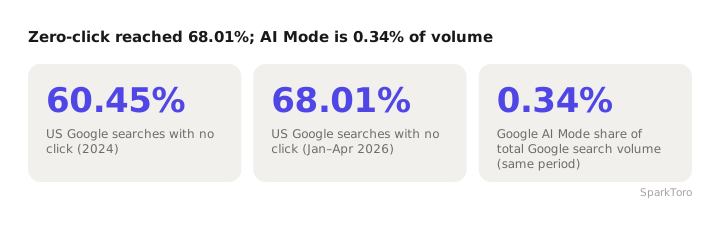
Between January and April 2026, 68.01% of US Google searches produced no click at all, up from 60.45% in 2024 (SparkToro / Similarweb panel, B). The direction is not in dispute.
The attribution is. The industry tells this as “users have switched to AI assistants”, but the same panel shows that Google AI Mode accounted for only 0.34% of total Google search volume over the same period (B). That magnitude cannot account for the lost clicks. The more plausible explanation is that the loss originates in the shape of Google’s own results page: AI Overviews, direct-answer modules, and the steadily expanding blocks Google gives to its own properties.
There is a contradiction here that must be presented as-is, not reconciled on the reader’s behalf. At I/O 2026, Google stated that AI Mode had passed one billion monthly active users and that query volume was “more than doubling each quarter” (A, official claim). That sits two orders of magnitude away from the 0.34% third-party panel measurement.
Both numbers can be non-false at once. They may be measuring different things: an official “monthly active users” figure can include passive exposure, whereas the panel measures active queries as a share of total search volume, and panels are structurally weak at covering in-app behaviour on mobile. But for a procurement decision, the point is not who is right. The point is this: in this category, the platform’s own metric and independent measurement can differ by a factor of one hundred, and most vendors quote only whichever of the two suits their pitch.
Practical implication: any proposal premised on “AI Mode has already reshaped demand” cannot produce clickstream evidence for that claim today. What is arguable is directional trend and structural risk. What is not arguable is current traffic volume. A proposal that conflates the two should be asked to show its measurement method.
1.2 Click-through rate: a measurable recovery after the fall
The most-quoted figure on the click-through impact of AI Overviews is −61%. It has a source, but quoting it alone is no longer accurate.
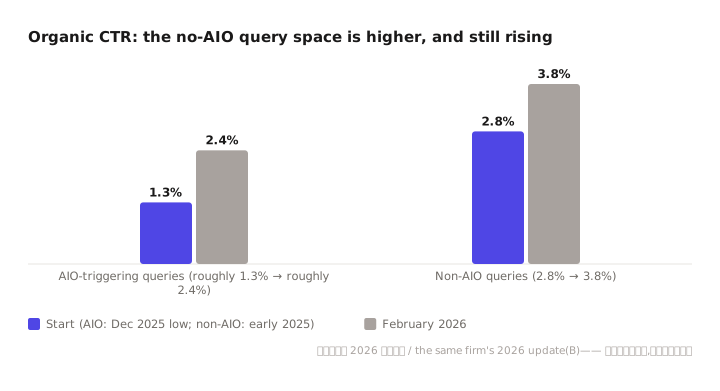
The 2026 update from the same firm shows that on queries that trigger an AI Overview, organic CTR recovered from a low of roughly 1.3% in December 2025 to roughly 2.4% in February 2026 (B); while on queries that do not trigger an AI Overview, CTR rose from 2.8% in early 2025 to 3.8% in February 2026 (B).
Taken together these give a specific, actionable conclusion that runs against the prevailing narrative: the query space without AI Overviews is today the higher-yield target, not residual traffic. Its absolute CTR is higher than that of AIO queries, and it is still rising.
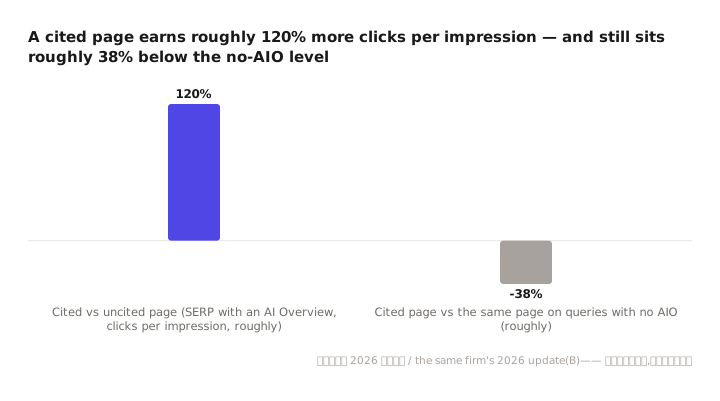
The same research also quantifies the value of GEO honestly: on results pages containing an AI Overview, a cited brand page earns roughly 120% more clicks per impression than an uncited page, but still performs roughly 38% below the same page on queries with no AIO (B).
Discipline: this report requires that the +120% figure never appears on its own. Being cited is genuinely and materially better, but it does not restore performance to the pre-AI-Overview level. Presenting only the first half is handing a CFO an expectation that will later be falsified.
On AI Overview trigger rates, this report gives no single figure. Existing measurements range from 15.69% to roughly 50% (C), and the spread comes from keyword-set composition and sampling method, not from disagreement about facts. Any material that quotes “about 50%” as a flat fact should be treated as not having been methodologically reviewed.
1.3 The real inflection happened in court
On 28 May 2026 the Regional Court of Munich I (LG München I, case 26 O 869/26) issued a preliminary injunction holding that content within AI Overviews constitutes Google’s own statements, and rejected Google’s reliance on the hosting-provider liability exemption under the Digital Services Act (A; preliminary ruling, under appeal).
In the same period, the behavioural remedies in the US antitrust case took effect on 3 February 2026, with a scope extending to the Gemini app and assistant (A).
This thread is almost entirely absent from the existing marketing conversation, yet it changes the nature of the problem:
- If an AI answer is the platform’s own speech, then a factually incorrect statement about a brand inside that answer is not merely a marketing problem but an actionable legal exposure.
- That creates a new and measurable requirement on the brand side: continuously recording factually incorrect statements about the brand in AI answers, and preserving reproducible evidence of them.
Canlah’s browser-level probe layer is built for exactly this use: timestamped interface screenshots, complete source lists, residential IPs, market separation. But it must be said plainly: the value of this service line depends on whether the ruling survives. It is currently a preliminary injunction under appeal and should not be sold as settled law.
The part that holds today and does not depend on how the rulings go is this: false factual statements about you in AI answers damage your commercial interests however the law develops, and the evidence is perishable — once the model updates, it can no longer be obtained. Timestamped screen captures and complete source lists are worth having today as grounds for correction and for holding vendors to account; if the rulings stand, they acquire legal value in addition. We price for the former and count the latter as nothing.
1.4 Platform landscape: the single-platform assumption has failed
| Platform | Share of global AI-chat product web visits, May 2026 |
|---|---|
| ChatGPT | 53.9% |
| Gemini | 27.9% |
| Claude | 9.2% |
| DeepSeek | 4.1% |
| Grok | 2.4% |
| Perplexity | 1.3% |
| Microsoft Copilot | 1.3% |
Source: Momentic compilation of Similarweb estimates, May 2026 data (B)
Three things are worth noting. First, ChatGPT is simultaneously growing in absolute users (passing one billion monthly actives in June 2026) and falling in relative share (roughly 76% to roughly 53%). That is not a contradiction; the market is expanding faster than any single player. Second, Copilot collapsed from roughly 13.2% to 1.3%, and Claude overtook it. Third, DeepSeek enters the top four on 4.1% of global share, a position entirely disproportionate to its standing inside China (see Chapter 6).
Practical implication: a GEO engagement measured only on ChatGPT covers roughly half the market today. Multi-engine measurement is not a premium feature. It is the pass mark.