WHITEPAPER · Part 8 of 13Full text
Chapter 5 · Discovery Moved Forward, Checkout Moved Back: The Real State of Agentic Commerce
Marketing in the Agent Era · Canlah AI · a Singapore SEO + GEO agency
✓You are reading the complete text — not a summary. All 13 chapters are published in full, free, no registration. The PDF is a print edition of the same content.
5.1 A premise that needs correcting
For the past year the dominant story in agentic commerce has been “be first to plug into a checkout protocol”. That premise stopped holding in 2026.
On 24 March 2026 OpenAI discontinued Instant Checkout inside ChatGPT (A), repositioning the Agentic Commerce Protocol as plumbing beneath a merchant’s own App rather than a direct in-conversation buy path. The stated rationale: transactions move into Apps, and the company prioritises product discovery.
The scale comparison is worth recording. Between launch in September 2025 and shutdown, roughly 30 Shopify merchants were actually live (B, per Forrester analyst Emily Pfeiffer; other reporting puts it at about 12), against launch messaging that described over a million Shopify merchants as imminently onboarding.
The merchants running a genuine commercial loop inside ChatGPT today are all integrated as Apps, not through the checkout interface: Target (19 Nov 2025), Instacart (12 Dec 2025), DoorDash (19 Dec 2025), Knot (4 Feb 2026) (A).
Forrester’s 28 May 2026 assessment serves as this chapter’s one-line summary (A): the market narrative is running ahead of real behaviour; answer engines are reshaping discovery, not yet checkout.
5.2 Google is the side actually shipping
Against OpenAI’s retreat, Google has continued to ship:
- UCP (Universal Commerce Protocol) requires
merchants to publish a JSON manifest at
/.well-known/ucpdeclaring services and capabilities (checkout / discount / fulfillment), bindable over REST, MCP or A2A. Checkout is implemented asPOST/PUT /checkout-sessions, carryingUCP-Agent,request-signatureandidempotency-keyheaders. Integration on Google’s side additionally requires a valid Merchant Center account with checkout-eligible products (A). - UCP was developed by Google with Shopify, Etsy, Wayfair, Target and Walmart, and is endorsed by 20-plus payment and retail partners. Onboarding begins with an intent form: this is controlled access, not open access (A).
- Google I/O 2026 introduced Universal Cart (a persistent cart spanning Search, Gemini, YouTube and Gmail), upgraded AP2 to allow agents to complete purchases autonomously, and extended UCP checkout to Canada and Australia, with the UK planned (A).
Maturity doubts about AP2 belong in the same paragraph (C): the protocol launched in September 2025 with 60-plus initial payment partners, but had only reached v0.2 by April 2026. Critics note it does not resolve agent identity — the authorisation credential binds to the user’s signing key rather than the agent’s — and it has not been tested at meaningful card-network transaction volume.
5.3 Canlah first-party data: agent readiness among Chinese cross-border DTC brands
This is original measurement. To our knowledge no equivalent has been published.
On 11 August 2026 we ran a read-only HTTP audit of the owned sites of
50 Chinese cross-border DTC brands; 47 were reachable. The checks
covered the preconditions an agent actually needs in 2026: a UCP
manifest, an agent-payments endpoint, llms.txt, AI-crawler
policy in robots.txt, and structured data on product pages.
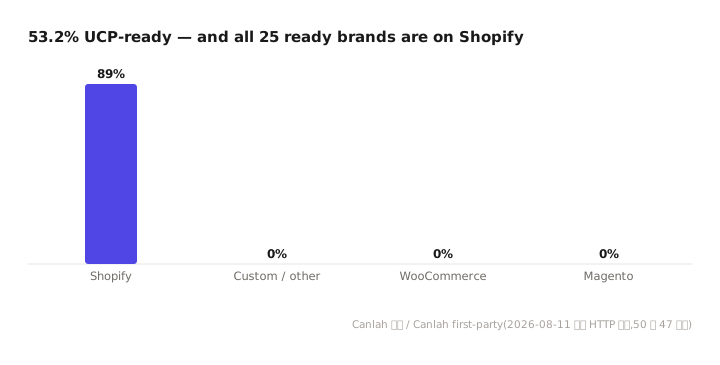
Finding one: checkout-layer readiness looks high — and not one brand did it themselves.
| Commerce platform | Brands | UCP-ready | Rate |
|---|---|---|---|
| Shopify | 28 | 25 | 89% |
| Custom / other | 17 | 0 | 0% |
| WooCommerce | 1 | 0 | 0% |
| Magento | 1 | 0 | 0% |
Overall UCP readiness is 25 / 47 = 53.2%. Every one
of the 25 ready brands is on Shopify; no non-Shopify
brand qualifies. All 25 manifests carry the identical
version string (2026-04-08).
The conclusion is unambiguous: that 53% is the platform’s doing, not the brands’. Reading it as “the industry has completed its agentic checkout preparation” mistakes a platform default for merchant strategy.
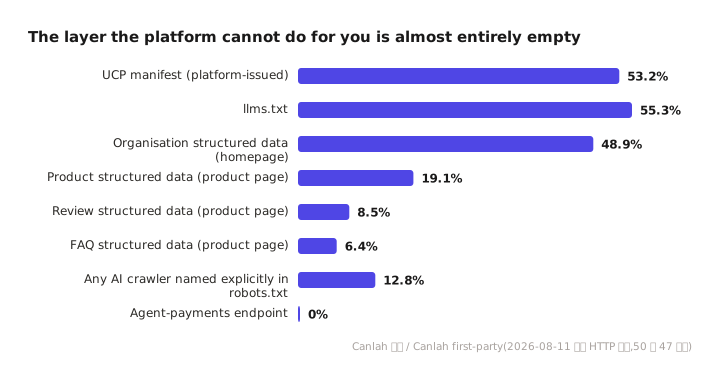
Finding two: the layer the platform cannot do for you is almost entirely empty.
| Check | Ready / reachable | Rate |
|---|---|---|
| UCP manifest (platform-issued) | 25 / 47 | 53.2% |
llms.txt |
26 / 47 | 55.3% |
| Organisation structured data (homepage) | 23 / 47 | 48.9% |
| Product structured data (product page) | 9 / 47 | 19.1% |
| Review structured data (product page) | 4 / 47 | 8.5% |
| FAQ structured data (product page) | 3 / 47 | 6.4% |
| Any AI crawler named explicitly in robots.txt | 6 / 47 | 12.8% |
| Agent-payments endpoint | 0 / 47 | 0% |
This table is the core of the chapter. The checkout pipe is a gift from the platform. The things that determine whether an agent can correctly understand, compare and restate your product — structured expression of specifications, price, stock, reviews and common questions — are absent at four brands in five.
Set against the simulation in Chapter 2 (a rating advantage of under +0.1 stars is enough to overturn a brand prior), the 8.5% coverage of review structured data deserves particular attention: in an environment where marginal rating differences drive recommendation, more than nine brands in ten have not made their own ratings reliably machine-readable.
Method and limitations (full method in Appendix A):
the sample is a convenience sample of 50 Chinese cross-border DTC sites,
not a random sample, and does not generalise to the population.
Detection was a single read-only request; regional variation or anti-bot
blocking may have caused false negatives. Structured-data checks covered
only the homepage and one product page discovered from it, so they do
not represent site-wide coverage. Both llms.txt and UCP
were content-validated (rejecting soft 404s that return HTML, and
malformed JSON); without validation, the initial run inflated
UCP readiness to 59.6% against the validated figure of 53.2%.
Raw data and audit script are published with this report.
5.4 The agents themselves are not yet reliable
Before spending against “make it easier for agents to buy”, it is worth knowing how badly agents currently buy.
EComAgentBench (June 2026, A−): across 662 shopping tasks built on real Amazon products and reviews, the strongest of seven tested models reached overall accuracy of only 57.1%; performance degraded systematically as requirements shifted from explicit queries towards user profiles and clarifying follow-ups.
The consumer-side trust gap is equally clear (B): 27% of consumers do not trust any organisation to operate an AI shopping agent, and 24% say they would never delegate a purchase decision to AI. Acceptance is markedly higher for using AI to compare and shortlist. The fault line is not “AI or no AI”, it is between assisted decision-making and delegated purchasing — consistent with this chapter’s overall reading.
5.5 But the discovery growth is real
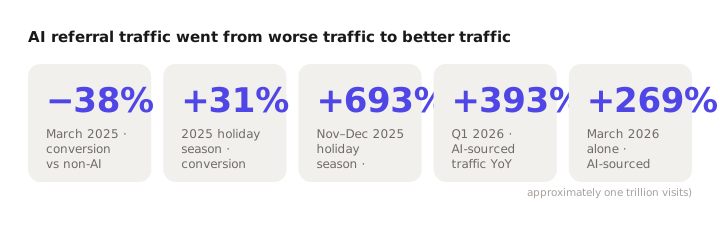
None of the above argues that agentic commerce is a fiction. The discovery data is strong (A, Adobe Analytics, covering approximately one trillion visits):
- In Q1 2026, AI-sourced traffic to US retail sites grew 393% year on year (March alone +269%); the November–December 2025 holiday season grew 693% year on year.
- Conversion quality reversed: in March 2025, AI-sourced visits converted 38% below non-AI sources; by the 2025 holiday season they converted 31% above (54% above on Thanksgiving Day), with time on site up 45% and bounce rate down 33%.
The reversal matters more than the absolute numbers: AI referral traffic went from worse traffic to better traffic — from a base that remains small.
5.6 Movement on the legal layer
On 4 August 2026 the US Court of Appeals for the Ninth Circuit vacated (vacate, not reverse) the preliminary injunction Amazon had obtained against Perplexity AI’s Comet shopping agent in Amazon.com Services, LLC v. Perplexity AI, Inc. (No. 26-1444), and remanded. The court found Amazon unlikely to establish a violation of the Computer Fraud and Abuse Act, on the basis that it is the user, not Perplexity, who accesses Amazon’s systems (A).
This is the first federal appellate ruling on whether an AI agent may access a platform on a user’s behalf. It is a procedural vacatur, not a final judgment, but the direction favours brands: the legal basis for a retail platform unilaterally excluding third-party shopping agents by technical means is weaker than previously assumed.
5.7 Actionable conclusion
The correct order of investment for 2026:
- Product data hygiene (structured expression of specifications, price, stock, availability) — four brands in five fail here;
- Answer readiness (review and FAQ structured data) — under 10% coverage, and directly tied to the recommendation mechanism;
- Verify platform preconditions (is the UCP manifest platform-issued; does Merchant Center hold checkout-eligible products) — most brands do not know whether they qualify;
- Building your own checkout pipe — unless you are off the mainstream platforms, this is not the year for it.