WHITEPAPER · Part 9 of 13Full text
Chapter 6 · How Closed Ecosystems Decide What to Trust: Vertical Authority and Ecosystem Affiliation
Marketing in the Agent Era · Canlah AI · a Singapore SEO + GEO agency
✓You are reading the complete text — not a summary. All 13 chapters are published in full, free, no registration. The PDF is a print edition of the same content.
6.1 What we deleted, and why
An earlier draft of this report carried a core mechanism claim about the Chinese market: “Publishing the same content across five or more platforms raises citation weight in AI answers by 35–50%.”
That claim has been deleted. It cannot be sourced on either the Chinese or the English side — no study, dataset or methodology supports it. More importantly, the vertical data we were able to verify points to the opposite mechanism (see 6.3). The “multi-platform volume” strategy built on it has been deleted with it.
We record the deletion in the body text because the claim circulates widely in the Chinese-language GEO services market and is likely to appear in other proposals a reader receives. If a vendor shows you this number, ask for the primary source.
6.2 Scale: Chinese AI usage has entered a deep-use phase
QuestMobile, AI Application Market Half-Year Report 2026 (published 14 July 2026, A):
| Metric | Value |
|---|---|
| AI-native app MAU (May 2026) | 499 million, +85.4% YoY |
| First tier | Doubao (豆包, ByteDance’s consumer assistant) 382m · Qwen (千问, Alibaba’s assistant) 167m · DeepSeek 130m |
| Second tier (June 2026) | Tencent Yuanbao (元宝) 49.84m · Ant Group Afu (阿福) 28.97m · Doubao Aixue (豆包爱学, its study-focused sibling) 19.44m · Kimi 7.29m |
| Handset-maker pre-installed assistants | 755 million, +14.0% YoY (larger reach, markedly lower use frequency) |
| Depth of use (May 2026) | 92.7 sessions / 183 minutes per user per month |
| Per-product time (April 2026) | Doubao 144.6 min (+80.6%) · DeepSeek 109.5 min (+106.9%) |
Definitional warning: the QuestMobile figures above exclude handset-maker pre-installed assistants, counting only independently downloaded apps. A second tracker, AI Product Ranking (AICPB), produces materially different results for the same period — its Yuanbao figure is roughly double QuestMobile’s, and Quark (夸克, Alibaba’s search-and-assistant app) is absent from QuestMobile’s AI-native ranking altogether (B/C; the definitional gap has not been independently verified, so we do not cite AICPB’s specific values).
Any material arguing the shape of the Chinese market from a single MAU figure has skipped this problem. Our position: the ordering is broadly stable (Doubao > Qwen > DeepSeek > Yuanbao); the absolute values depend on definition and should not be quoted precisely.
The growth in depth of use deserves separate attention: Doubao and DeepSeek grew monthly minutes per user by 80.6% and 106.9% year on year. Growth is coming from depth, not only from new users. Answers on these platforms are being consumed repeatedly by the same people, which means the compounding effect of a factual misstatement about a brand is larger than the traffic figures suggest.
6.3 Mechanism: vertical authority × ecosystem affiliation
China now has a domestic equivalent of the “most-cited sources” measurement. QuestMobile’s Research Report on AI Platform Trust Logic and Source Preference (data window April–May 2026, A) measured source citation rates across Doubao, DeepSeek and Qwen.
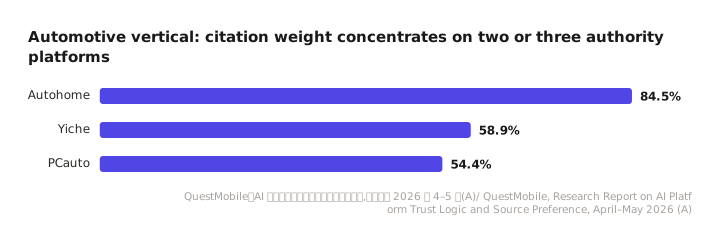
Automotive vertical (the sample this report uses; every line independently verified):
| Source | Citation rate |
|---|---|
| Autohome (汽车之家, China’s leading car-buying portal) | 84.5% |
| Yiche (易车, a comparable auto portal) | 58.9% |
| PCauto (太平洋汽车, a long-established auto site) | 54.4% |
Extreme concentration by model: on car-recommendation questions, Qwen cites Dongchedi (懂车帝, ByteDance’s auto vertical) 76.5% of the time; DeepSeek cites Yiche 80.6% of the time.
The mechanism this describes is the exact inverse of “publish everywhere”:
Within a vertical, citation weight concentrates heavily on two or three authority platforms, and different models prefer different ones among them. What determines whether you are cited is the quality of your presence on that vertical’s authority platforms, and that platform’s ecosystem affiliation with the target model — not how many platforms you published to.
The ecosystem affiliation layer has independent Chinese-language support. Soochow Securities, Generative Engine Optimisation (GEO): the first commercialisation frontier for large models (16 January 2026, 23 pages, B — a brokerage note is analyst opinion, and its corpus-mapping conclusions rest on the analysts’ own January 2026 testing rather than third-party measurement) argues that Doubao weights ByteDance’s ecosystem heavily (Toutiao 今日头条, its news aggregator; Douyin 抖音, the domestic TikTok), while Tencent’s Yuanbao weights the WeChat ecosystem (Official Accounts 公众号, Channels 视频号, and Zhihu 知乎, China’s Quora-equivalent Q&A site). This runs in the same direction as QuestMobile’s measurement: Doubao’s citations concentrate in ByteDance’s own content pool, while DeepSeek, having no proprietary content ecosystem, leans more on general portals.
(We deleted several “per-model citation rate for a specific platform” percentages from this report — those particular figures could not be located in the QuestMobile report or its press coverage. The qualitative mechanism has independent support and is retained; the specific percentages must not be quoted.)
6.4 Content assets are becoming a distribution channel in their own right
One further set of estimates from QuestMobile’s 2026 half-year report deserves separate billing (A):
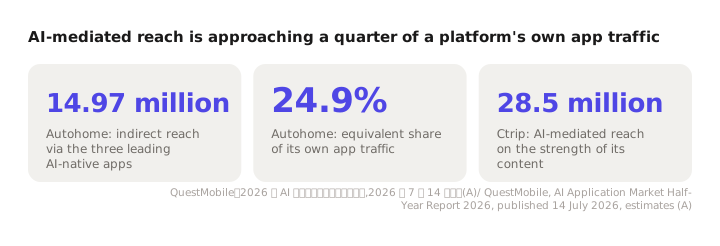
- Ctrip (携程, China’s largest online travel agency) generated 28.5 million AI-mediated reach on the strength of its content;
- Autohome’s content, structurally invoked by the three leading AI-native apps, produced 14.97 million indirect reach — equivalent to 24.9% of its own app traffic.
That 24.9% is the most strategically significant number in this chapter. For a content platform, AI invocation now delivers reach approaching a quarter of its own app traffic — reach that occurs outside its own product, outside its control, and outside its DAU.
For brands the implication is: the real audience for content you publish on a vertical authority platform already exceeds that platform’s own user base. That re-prices what it means to place a piece of content in trade media.
6.5 Adversarial evidence: the industry is being publicly described as black-hat SEO in new packaging
Anyone selling GEO to Chinese clients, or to Chinese brands going abroad, has to answer this first.
Reporting by Xinhuanet (新华网, the state news agency’s online arm) documents industry practices including (C — aggregated media reporting, not systematic research): bulk-publishing low-quality or fabricated advertorials at ten to a few tens of yuan apiece to contaminate model sources (so-called “AI poisoning”); fabricated authority endorsements; fabricated expert credentials; and “shadow sites” built to be read only by AI while blocking human visitors.
One example is worth recording specifically: multiple Chinese GEO marketing materials cite the 2025 Generative Engine Optimisation Industry White Paper from CAICT (中国信通院, the China Academy of Information and Communications Technology, the MIIT-affiliated state research institute) as authoritative backing. That report does not exist. This matches the error-propagation mechanism described in this report’s preface, only worse: it is not distortion in retelling, it is invention.
Business-model scepticism is equally public: an industry cost breakdown claims that an 8,000-post bulk package costs about ¥440 to fulfil and sells for ¥19,800, a gross margin of roughly 97.8% (C, single source, not independently verified). Nor is there consensus on the size of the Chinese GEO market: iResearch (艾瑞咨询) estimates roughly ¥600 million in 2025 rising past ¥50 billion by 2030, while an advertorial-flavoured industry “white paper” claims ¥12.76 billion already in 2025. The two differ by more than 20 times. This report adopts neither figure and records only the disagreement.
6.6 Platform enforcement has already landed, and volume strategies are now a risk
This is not a forecast. It has happened:
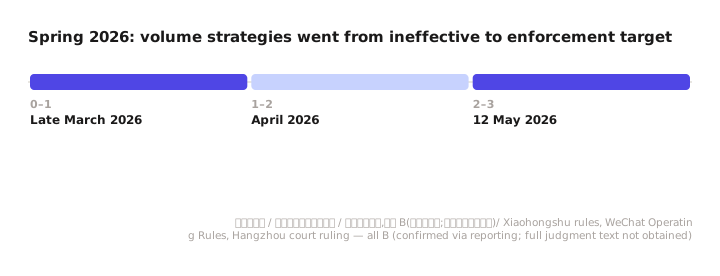
- Xiaohongshu (小红书, the lifestyle UGC and product-discovery platform often glossed as RED) published its AI-Generated Content Management Rules in April 2026, requiring creators to declare AI involvement, with the platform applying AI labels where they do not. Penalties are graduated, and fully AI-operated accounts and AI account matrices are banned outright (B).
- WeChat Official Accounts Platform updated Article 3.27 of its Operating Rules in late March 2026 (B).
- On 12 May 2026 the Hangzhou Intermediate People’s Court issued an unfair-competition ruling on AI-generated bulk “seeding” posts, ordering the operator of the AI tool to pay ¥100,000 in damages (B, confirmed via reporting; the full judgment text was not obtained).
The implication is direct: the “same content across many platforms” strategy proposed in our own earlier draft is today not merely ineffective — it is an explicit enforcement target. Recommending it to a client means selling them account-ban risk.
6.7 Actionable conclusion
- Choose the vertical, not the count. Identify the two or three authority platforms with the highest citation rates in your vertical and concentrate resource on the quality of your presence there.
- Order by the target model’s ecosystem affiliation. Targeting Doubao means the ByteDance properties; targeting Yuanbao means the WeChat properties; targeting DeepSeek means general portals and generic authority sources.
- Price content assets by their AI-mediated reach, not by the host platform’s own traffic. Autohome’s 24.9% is a transferable way to think about it.
- No bulk publishing, no AI-operated account matrices. Platforms are enforcing, and a court has ruled.
- Require any Chinese GEO vendor to produce primary sources. Citation of a non-existent report is already on the record in this market.