WHITEPAPER · Part 11 of 13Full text
Chapter 8 · Starting From Here
Marketing in the Agent Era · Canlah AI · a Singapore SEO + GEO agency
✓You are reading the complete text — not a summary. All 13 chapters are published in full, free, no registration. The PDF is a print edition of the same content.
This report has argued throughout that the promises made in this category should not be taken on trust. Our own promises should then be measured with the same ruler. What follows is what we give away, what you can obtain by leaving your contact details, what we charge for, and the circumstances in which we will tell you not to buy.
Pricing basis: the figures below are our August 2026 rates; for ongoing engagements, the configuration and the price are set by the scope sheet issued after the deep diagnostic. A PDF circulates for more than a year; prices do not stay unchanged for a year.
8.1 Fully public, no gate: this report itself
The full text of this report is published as a web page at canlah.ai/whitepaper. There is no reading gate, no lead-capture requirement, and AI engines are permitted to crawl and cite it. The PDF in your hands is a print version of the same content, not a “complete version”.
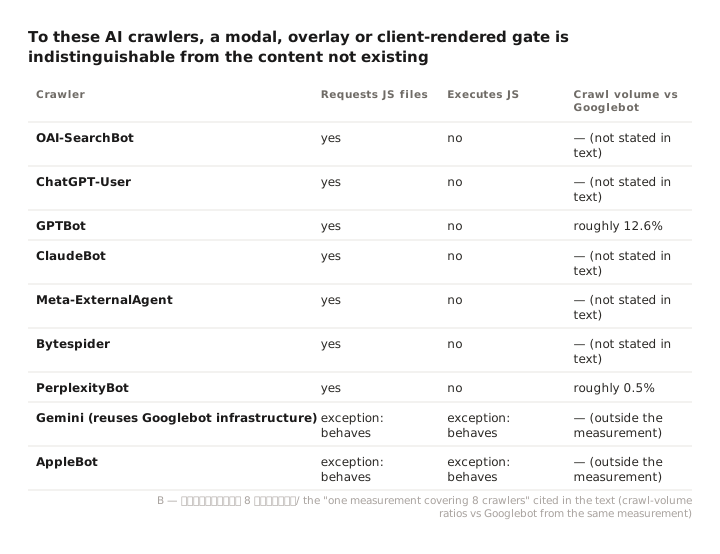
We do not put the body text behind a form, and the reason is mechanical rather than a matter of posture. Measurement shows that the major AI crawlers do not execute JavaScript — in one measurement covering 8 crawlers, with 0 of them rendering JavaScript, OAI-SearchBot, ChatGPT-User, GPTBot, ClaudeBot, Meta-ExternalAgent, Bytespider and PerplexityBot each requested JavaScript files without executing them (B). Two engines outside that set behave differently: Gemini, which reuses Googlebot infrastructure, and AppleBot. Any gate implemented as a modal, a scroll overlay or client-side rendering is, to these engines, indistinguishable from the content not existing.
There is a second thing we do not do: serve different content by user agent — full text when the requester is identified as a crawler, a form when it is identified as a person. Google’s spam policies define presenting different content to users and to search engines as cloaking (A). For a company that stands on an evidence standard, that is an order of magnitude worse than putting up a gate.
One fact that runs against us has to be stated: the same measurement shows AI crawl volume an order of magnitude below Googlebot — GPTBot at roughly 12.6% of Googlebot, PerplexityBot at roughly 0.5% (B). Publishing openly for AI citation is therefore a long-term position, not a current source of traffic. We publish this report on that basis, and we promise no one traffic on that basis.
(A further point: Google grants an explicit exemption for paywalls — with correct structured markup, gating content is not a violation in Google Search (A). The conclusion of this section is therefore only that we choose not to gate, not that gating is penalised.)
8.2 Available if you leave your contact details: the evidence pack
The body text is ungated, but there is a class of material for which we will ask who you are first:
- The redacted DeepAudit client sample — 58 pages in Chinese / 66 pages in English. This is an original client deliverable, with identity masked only: brand, domain, address and contact names replaced by masks; competitors retained under distinguishable numbering; screenshots pixelated in full to demonstrate that a real screenshot exists. Scores, mention counts, ranges, charts and page structure are unmodified.
- The GEO case library by vertical — healthcare, infant formula, dietary supplements, personal brands and others, supplied as separate volumes.
- The PDF print version of this report, together with a fillable template for the prompt-panel rules set out in Chapter 4.
How to request them: tick the evidence-pack box at canlah.ai/whitepaper, or write to admin@canlah.ai with your domain and main sales markets.
Why these require contact details when the body text does not: they are not our opinions, they are client assets. Even redacted, sending an original client audit to someone whose identity is entirely unknown to us is not something we should do. That reasoning does not apply to the report above — that is our own argument, and hiding it would only make it unreadable and uncitable.
8.3 The paid product: the DeepAudit deep diagnostic
US$99 per report — order at canlah.ai/deep-audit. Once you sign, this item is included in the service package.
We set it at this price not because it is cheap to produce, but because its function is filtering, not revenue. US$99 is enough to filter out the casual click, and low enough that no sales call needs to be scheduled first — you do not have to sit through our methodology in order to read a diagnostic.
What is delivered: probing across the full query pool, reverse engineering of the sources cited for competitors, a site audit, and a strategy blueprint. The raw answer for every query on every engine is archived with a UTC timestamp and a browser-level screenshot; the full source list is included; each market is measured and reported separately, with no synthesis into a single global score (the measurement specification in Chapter 4 applies throughout).
The evidence is yours. Screenshots, raw answers and source lists remain your assets whether or not the engagement continues. The redacted sample in 8.2 is this deliverable — the granularity you see there is the granularity you receive once you commission it, with the names changed to yours.
What it does not include: remediation tickets, the 90-day re-test, and multi-round confidence intervals — those belong to an ongoing engagement, not to a one-off diagnostic. It also does not answer causation, attribution, or “how much will this lift after we fix it” (see Chapter 3; no one can answer that honestly). We write the boundary next to the price so that the price holds up.
Capacity is capped, and we say so plainly: the browser-level notarisation layer runs one engagement at a time, and monthly capacity under the current configuration is limited. This is not a scarcity tactic — if the schedule is full, we will tell you how long the wait is rather than downgrade to API-layer probing in order to take the booking.
8.4 Why we charge for this item
Three reasons, in order of importance:
- Charging is what allows us to say “you do not have a problem”. A free diagnostic exists in order to sell the engagement that follows it, so structurally it is not permitted to conclude that you should not buy. We charge US$99 so that this report has the standing to tell you that you do not need this — the situations set out in 8.6 are ones a free diagnostic cannot honestly write down.
- Browser-level probing carries a real marginal cost. The specification in Chapter 4 — residential IPs, logged-out state, real browsers, multiple rounds, market separation — is not a configuration toggle; every probe spends money. Making it free leaves two routes: subsidise it, or quietly downgrade to API-layer probing — and the API layer is precisely the layer Chapter 4 shows to be distorted.
- The price is a filter, not a profit line. US$99 covers the cost of probing and issuing the report, and once you sign it is folded into the service package — we do not expect to make money on this item, only to have it stop the wrong projects before they start. See 8.6.
8.5 Where a deep diagnostic differs from a free scan
A free scan gives you a number. A deep diagnostic gives you an accountable, reproducible, market-separated measurement record. That difference is not “we check more” — it is the data below.
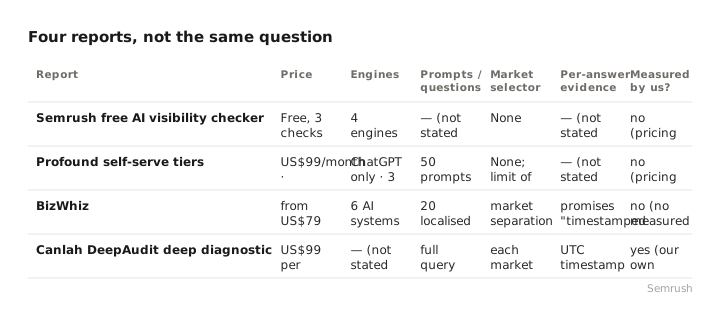
Per both vendors’ published pricing pages as read on 12 August 2026 (A, vendor official pricing page, read that day): Semrush’s free AI visibility checker allows 3 checks per day, requires no sign-up, and covers 4 engines, and the free report already includes a visibility score, mentions, citations, cited pages and competitor comparison. In other words, “4 engines plus competitor comparison” is available at no cost, so it cannot be what we sell. Profound’s self-serve tiers are US$99/month (ChatGPT only, 50 prompts) and US$399/month (3 engines, 100 prompts), and both tiers state a limit of 1 language and 1 region.
There is only one real difference: these tools have a domain input field, but no market selector. They give you a number, and that number was measured in one particular environment. We have not reused the vendor experiment circulating in the industry that reports a 48-percentage-point gap between logged-in and logged-out states — by this report’s standard it rates only C (single prompt, single category, vendor self-test, dataset not published). We answer with our own data instead.
Canlah first-party · cross-client two-layer comparison (13 August 2026)
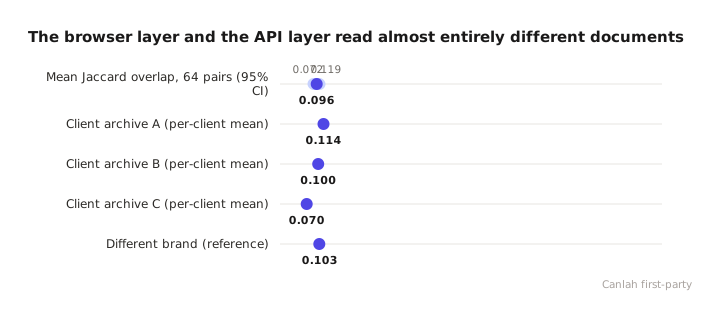
We paired the records in three real client audits where the same query was issued to the browser layer and the API layer at the same time, giving 64 pairs:
| Metric | Value |
|---|---|
| Mean Jaccard overlap of cited sources between the two layers | 0.096 (median 0.083 · sd 0.096) |
| 95% confidence interval | [0.072, 0.119] |
| Queries with no overlap at all between the two layers’ sources | 21 / 64 = 33% |
| Per-client mean, after re-attributing 16 misfiled pairs (see A.5) | 0.114 / 0.100 / 0.070 (two verticals, two markets) |
The two layers are reading almost entirely different documents. Three client archives land in the same range, and this corroborates the 0.103 we measured on a different brand in July 2026 — with the attribution caveat recorded in A.5.
We must state one finding that runs against us: 15 of the 64 pairs disagree on whether the client was cited (11 before the re-attribution in A.5), and every one of them is a case where the API layer registered a hit that the browser layer did not reproduce — it is not that “the API layer misses you”. That rules out the version of the story that would have been easier for us to sell. The real conclusion is this: the two layers produce errors in opposite directions, so they are not two samples of one measurement; they are two different measurements. Which one is closer to what a real user sees depends on whether your customers read the answer in a browser or consume it through an API — for the large majority of DTC brands, it is the former.
Limitations of this dataset: 3 brands, 64 pairs, all
drawn from our own clients, not a random sample; pairing was done by
matching normalized query text, so the exact wording of the prompt may
differ slightly between layers. The pairing script is published with
this report (_source/browser-vs-api-comparison.py for the
means; _source/browser-vs-api-pairwise.py for the per-pair
values behind the median, sd and CI) and can be re-run.
So for a brand selling into the US, the UK and Japan at the same time, the free number is not a cheaper version of what we do. It is the answer to a different question. The reverse also holds: if you operate in one market and only want to know whether you are being mentioned, the free tool is sufficient, and we suggest you use it rather than come to us.
There is a firm that deserves the comparison more than Semrush does. BizWhiz publishes a price from US$79 (A, pricing page on their own site, read 2026-08-13), with a specification of “20 localised questions × 6 AI systems, 100+ sampled answers”, and the same promise of “timestamped before-and-after samples”. On paper their coverage is broader than ours, at US$20 less. Not mentioning them would be dishonest.
Three things stated plainly:
- If that report meets your need, you should buy it and you do not need us. This is not a courtesy — see 8.6; we never intended to sell this to everyone.
- We have not run a measured comparison against it. We do not know whether its “6 AI systems” are browser-layer or API-layer, whether markets are separated, or whether the timestamped screenshots cover every single answer. Until we have done that work, we will not claim to be better — that is exactly the unevidenced claim Chapter 3 of this report criticises.
- All we can speak to is our own side: the 64 pairs above — 3 brands, Jaccard 0.096 — are our own data, the scripts are public, and the run is reproducible; every answer carries a UTC-timestamped screenshot and a complete source list; markets are reported separately; the evidence pack belongs to you. These are verifiable facts, not comparative conclusions about a competitor.
The two reports are US$20 apart, so this is not a budget question; it is a question of which kind of evidence you want. If what you want is a number with broader coverage, buy theirs. If what you want is an archive in which every answer can be traced to a UTC timestamp, a browser-level screenshot and a complete source list, and in which markets are reported separately, buy ours. Buying both is entirely reasonable — together they come to under US$200, and they will very likely reach different conclusions, which is itself something worth knowing.
8.6 When we would tell you not to buy
This section is not modesty; it is a filter:
- None of the four self-checks in Chapter 0 applies to you - your structured data is already in place. Go and work on the off-site authority material in Chapter 7; that part does not necessarily need us.
- You sell into one market only - market separation is the main reason we charge. With one market, that reason does not hold.
- You want guaranteed impressions - we do not sell that; see 8.7.
- You need to see a revenue change within 30 days - Chapter 3 sets out plainly that no one can demonstrate this. We will not accept that expectation.
- Your category does not yet have commercial queries inside AI answers - the free sample in 8.2 will tell you so, and we will then suggest you spend the money elsewhere and look again in six months.
8.7 Three things we do not do
These three are our pricing discipline, written here so that we can be held to them:
- We will never enter a guaranteed-impressions bidding war. We do not promise impression volume, because the data in Chapter 4 shows it cannot be measured stably. What we guarantee is that you will know where every dollar went.
- We will never promise category exclusivity. We do not sell “we serve only you in your category”, because it raises the price without creating any effect.
- We will never do undisclosed ghost-posting. All third-party content is labelled with its true source according to each platform’s rules. Chapter 6 records the enforcement actions and judgments this category has taken as a result.
8.8 The criteria we hold ourselves to
On any ongoing engagement:
- the prompt panel is published before work begins, including the generation rules, and is written by someone who does not know the answer
- a control group with no optimisation is established
- mention rate and source set have separately specified round counts and are reported separately, never synthesised into a single score
- every metric is reported as an interval, not a point value
- results are delivered as they are, whether or not they meet target
Chapter 4 states that a single measurement is invalid, and that our own sampling calibration holds only at the saturation endpoint. These commitments are our response to those limitations - not a way around them, but a decision to price their cost into our own costs rather than into false precision in your report.
8.9 Contact
admin@canlah.ai - include your domain and your main sales markets in the email.
- If you want to see your own numbers first: we will send back the free sample described in 8.2. No call required, no form required.
- If you want to order directly: we will send back a confirmation sheet setting out scope and the market list. The current basis is at admin@canlah.ai.
Get your own numbers first, then decide whether there is anything to discuss.