WHITEPAPER · Part 10 of 13Full text
Chapter 7 · Execution Discipline: A Ninety-Day Sequence and a Published Methodological Red Line
Marketing in the Agent Era · Canlah AI · a Singapore SEO + GEO agency
✓You are reading the complete text — not a summary. All 13 chapters are published in full, free, no registration. The PDF is a print edition of the same content.
7.1 Sequence follows the evidence, not the ease of delivery
Most GEO programmes run on-site work first, because on-site work is the easiest thing to deliver. The evidence in this report does not support that ordering.
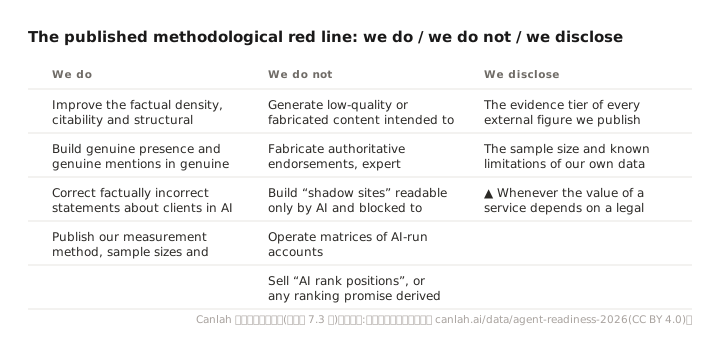
Section 3.5 showed that on-site GEO scores are uncorrelated with discovery rate; what does correlate is the number of referring domains and third-party community presence. Section 5.3 showed that platforms have already completed the checkout layer on merchants’ behalf, and that what merchants still owe is product data and answer-readiness. Chapter 6 showed that in China, citation is decided by the quality of your presence on the two or three authoritative platforms in your vertical.
Three independent lines of evidence point to the same conclusion: the centre of gravity is off-site, not on-site.
7.2 The ninety-day sequence
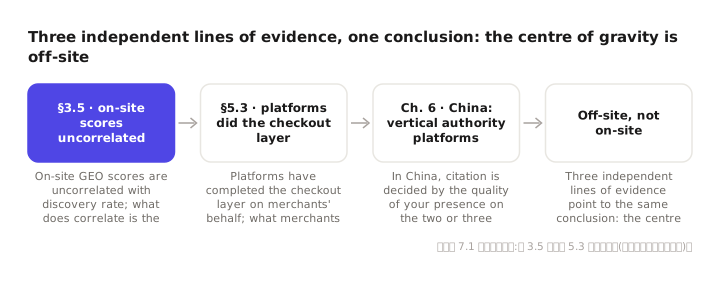
Days 1–15 · Establish the measurement baseline (no optimisation of any kind)
Pre-register the prompt panel: publish the full set and the generation rules, and have it written by someone who does not know the answers. Measure across engines — ChatGPT, Gemini, Claude and DeepSeek are the minimum set; for the Chinese market add Doubao (豆包, ByteDance’s assistant), Qwen (千问, Alibaba’s assistant) and Yuanbao (元宝, Tencent’s assistant). Take two rounds for mention rate, and state explicitly that the source set is a sample, not an enumeration. Headline evidence is browser-grade, with timestamped screen captures. In parallel, log every factually incorrect statement about the brand that appears in AI answers — this is the evidentiary basis for the legal thread in Section 1.3.
Days 16–45 · Entity and product data hygiene
This stage is necessary hygiene, not leverage, but everything that follows depends on it: entity consistency (name, category, market and key facts stated identically across the web); product structured data (Section 5.3 found 81% of brands missing it); review and Q&A structured data (missing in over 90% of cases); and verification of platform preconditions (whether the UCP manifest was issued by the platform, whether Merchant Center holds checkout-eligible products).
Days 46–75 · Off-site authority (the principal lever in this sequence)
Referring domains and third-party mentions are the operable variables with the strongest observed correlation. Western markets: trade media, Reddit and professional communities, and original data that can be cited. Chinese market: the two or three vertical authority platforms selected per Section 6.7, ordered by the ecosystem affiliation of the target model. No volume-seeding. No account matrices.
Days 76–90 · Re-measurement and honest attribution
Re-run the same pre-registered panel. Report intervals, not point values. Distinguish explicitly between change in mention rate (attributable) and change in the source set (sampling variance, not attributable). Any change that cannot be placed in a temporal correspondence with a specific optimisation action is labelled unattributed.
7.3 A published methodological red line
This section exists because the technical boundary between legitimate GEO and undetectable manipulation is blurred.
Existing research (work associated with GEO-Bench, A−) shows that black-box content rewriting can match or exceed gradient-based adversarial attacks at lifting rank, while evading both keyword-based and perplexity-based detection. In other words, a sufficiently refined “content optimisation” and a successful model manipulation may be indistinguishable at the level of detection.
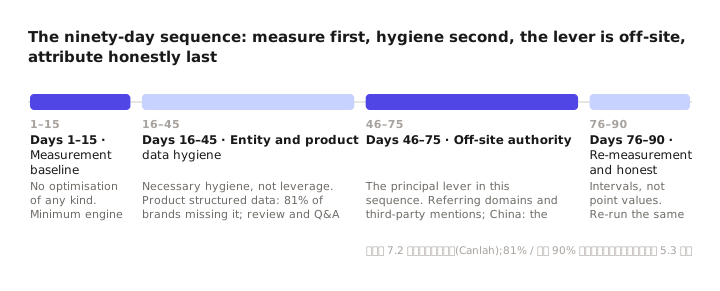
Where that is the case, the boundary cannot be defined technically. It can only be declared. Canlah’s red line is published below so that it can be checked.
We do:
- Improve the factual density, citability and structural clarity of genuine content
- Build genuine presence and genuine mentions in genuine third-party venues
- Correct factually incorrect statements about clients in AI answers
- Publish our measurement method, sample sizes and uncertainty intervals
We do not:
- Generate low-quality or fabricated content intended to pollute model source pools (so-called “AI poisoning”)
- Fabricate authoritative endorsements, expert credentials, institutional reports or reviews
- Build “shadow sites” readable only by AI and blocked to human visitors
- Operate matrices of AI-run accounts
- Sell “AI rank positions”, or any ranking promise derived from a single measurement
We disclose:
- The evidence tier of every external figure we publish
- The sample size and known limitations of our own data (see Appendix A)
- Whenever the value of a service depends on a legal ruling that is not yet final
The last of these matters most. In a category where measurement is unreliable and the causal effect has not been stably demonstrated, verifiability is the differentiation we have chosen — and it is defensible not because others cannot do it, but because doing it means living with the consequences.
Publishing our method means our conclusions can be overturned. Publishing our do-not-cite list means we can no longer use those convenient numbers. Publishing pre-registrations means we cannot move the criteria when the results look poor. Any competitor may adopt this standard, and we hope they will — but adopting it costs them the rhetorical room this category ordinarily enjoys.
This report publishes its raw dataset and its audit scripts for that reason — the cross-border DTC agent-readiness data is at canlah.ai/data/agent-readiness-2026 (CC BY 4.0, CSV plus the re-verification script): anyone can re-run the audits in Section 5.3 and Chapter 0 and tell us where we are wrong.