WHITEPAPER · Part 1 of 13Full text
Preface: The Evidence Standard Used in This Report
Marketing in the Agent Era · Canlah AI · a Singapore SEO + GEO agency
✓You are reading the complete text — not a summary. All 13 chapters are published in full, free, no registration. The PDF is a print edition of the same content.
Roughly two thirds of the statistics circulating in this category do not survive independent sourcing.
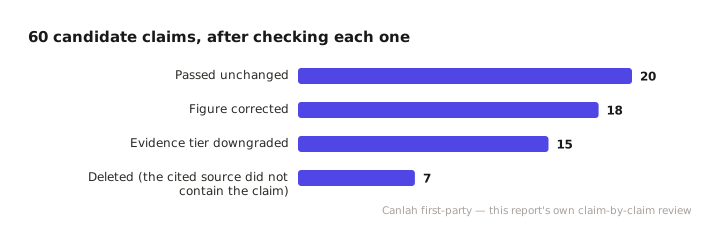
That is not a rhetorical flourish. In preparing this report we independently re-checked 60 candidate claims one by one — tracing each to its primary source, verifying the definition behind the number, checking the date. Only 20 (33%) passed unchanged. Eighteen figures required correction, fifteen had their evidence tier downgraded (most often because a vendor study or an official company statement had been treated as neutral data), and seven were deleted outright, because the sources they cited did not contain the statement attributed to them.
The deleted claims shared one characteristic: they were precise, useful, and unverifiable. They circulate between blogs, each retelling adding a little credibility, and nobody ever returns to the original source. This is the most dangerous class of error in this category, and it persists because almost nobody labels which tier their evidence comes from.
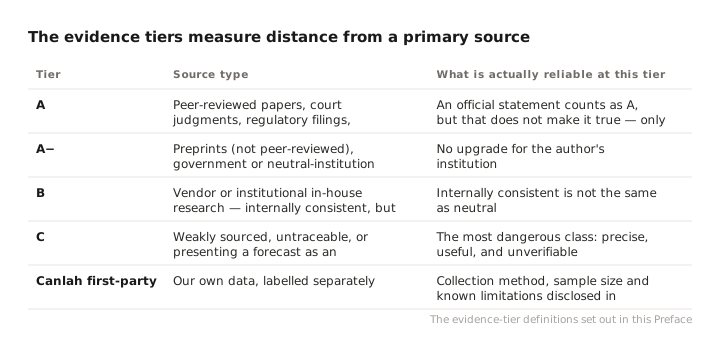
Accordingly, every external claim in this report carries an evidence tier:
| Tier | Meaning |
|---|---|
| A | Peer-reviewed papers, court judgments, regulatory filings, company financial reports, and official product documentation |
| A− | Preprints (not peer-reviewed), government or neutral-institution measurement |
| B | Vendor or institutional in-house research — internally consistent, but the publisher sells a related product |
| C | Weakly sourced, untraceable, or presenting a forecast as an accomplished fact |
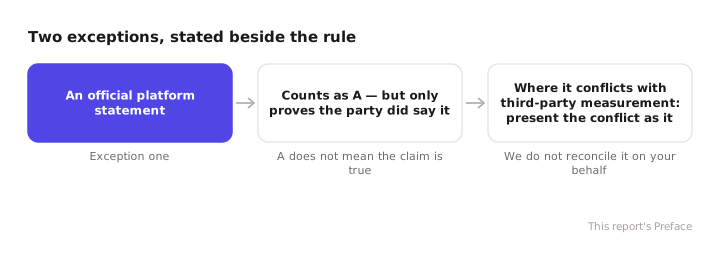
Two exceptions to the labelling rule are worth stating. An official platform statement counts as A, but that does not make it true — what is reliable is only the fact that the party in question did say it. Where such a statement conflicts with third-party measurement, we present the conflict as it stands and do not reconcile it on the reader’s behalf. Peer review is a hard threshold — of the academic literature cited here, exactly one paper is peer-reviewed (KDD ’24). The rest are 2026 preprints, all labelled A−, with no upgrade granted on the strength of an author’s institution.
Canlah’s own data is labelled separately as Canlah first-party, with collection method, sample size, and known limitations disclosed in Appendix A. Where a judgement is inferred rather than measured, the body text says “we infer”.