WHITEPAPER · Part 2 of 13Full text
Executive Summary
Marketing in the Agent Era · Canlah AI · a Singapore SEO + GEO agency
✓You are reading the complete text — not a summary. All 13 chapters are published in full, free, no registration. The PDF is a print edition of the same content.
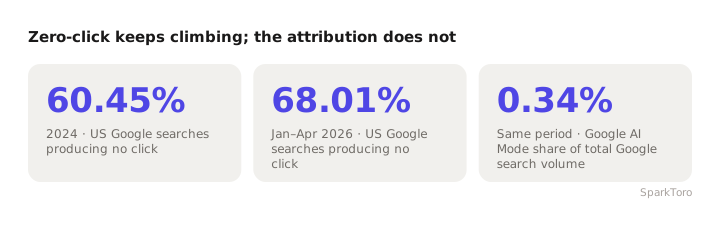
1. What actually changed in the first half of 2026 was not user behaviour, but the institutional environment. Zero-click rates continued to climb (68.01% of US Google searches produced no click in January–April 2026, against 60.45% in 2024), but attributing this to chatbots displacing search does not fit the clickstream data — over the same period, Google AI Mode accounted for just 0.34% of total Google search volume. The losses come from Google’s own results page, not from AI assistants. The real turning point happened in court: on 28 May 2026 the Munich Regional Court ruled that AI Overviews constitute Google’s own speech, rejecting its hosting-provider defence. That converts “how the AI answer describes us” from a marketing problem into a legal exposure.
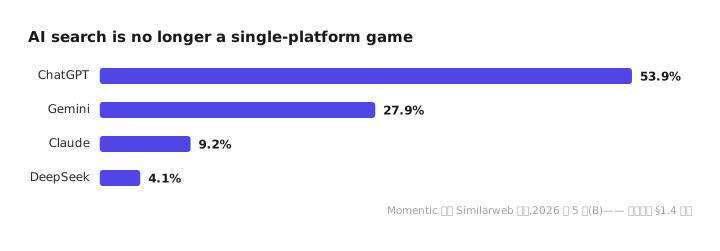
2. AI search is no longer a single-platform game. Global web-visit share of AI conversational products in May 2026: ChatGPT 53.9%, Gemini 27.9%, Claude 9.2%, DeepSeek 4.1%. A year earlier ChatGPT held roughly 76%. Any programme built on the assumption “optimise for ChatGPT first” today covers about half the market.
3. The limits of what GEO can do must be stated plainly, or none of it is credible. A critical review published in July 2026 covering 45 studies concluded that none of the techniques examined demonstrated a stable, longitudinal, cross-platform causal effect on organic discoverability. We agree with that conclusion, and Chapter 3 explains why it does not amount to “GEO does not work” — optimisation can change whether content that has already been retrieved gets cited, but has never been shown to change whether content is retrieved at all. Separating those two things is the most important methodological claim in this report. On that basis we have narrowed what we will deliver to diagnosis, error correction and pre-registered controlled experiments — the results of all three can be verified directly by the client at the point of delivery, without relying on the causal proposition holding.
4. The industry has merged two quantities of entirely different character into one score. Our sampling calibration shows that brand mention rate stabilises at round 1 and does not move by a single figure across seven further rounds; the set of cited sources was still gaining new entries at round 8 and never converges. “Was I mentioned” is cheap and stable; “who was cited” is expensive and unbounded. Any product selling a single AI visibility score is averaging a quantity that has converged against one that never has.
5. In agentic commerce, discovery has moved forward while settlement has moved back. OpenAI discontinued Instant Checkout on 24 March 2026, with only around 30 Shopify merchants live over its entire run, against the launch-time framing of “a million merchants coming soon”. The investment that pays in 2026 is product data and answer readiness, not checkout plumbing.
6. In China the mechanism of trust is vertical authority × ecosystem membership, not volume spread across platforms. We deleted from the draft of this report the claim that “publishing homogeneous content across five or more platforms raises citation weight by 35–50%” — it cannot be traced to a source, and the vertical data we did verify points to the opposite mechanism.
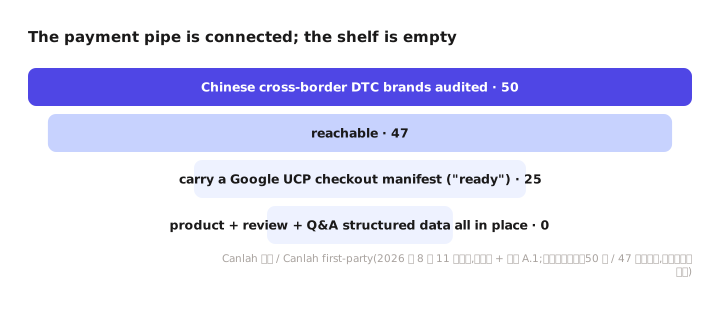
7. We audited 50 Chinese cross-border DTC brands for agent-readiness (47 reachable). The number with all three classes of structured data — product, review, Q&A — in place: 0. Seventy-nine per cent of the brands are missing all three. Seventeen of them already carry a Google UCP checkout manifest and are still missing all three — the payment pipe is connected and the shelf is empty: an agent can pay on the user’s behalf but cannot read what you sell. And not one of the 25 “ready” brands did it themselves: all 25 are on Shopify, with identical manifest version numbers. The platform has done the layer it can do for you; the remaining layer it cannot. The breakdown by vertical, and a thirty-second self-test, are in Chapter 0.
8. We have put our own prices and our own criteria into this report (Chapter 8). The body text is published free, with no reading gate, and AI engines are permitted to crawl and cite it — a company selling AI visibility should not hide its own argument where AI cannot read it. What requires your contact details is the evidence pack: a redacted sample of an original client deliverable (58 pages in Chinese / 66 pages in English) and the case library by vertical — those are client assets rather than our opinions, so we ask who you are first. What is paid for is the product: the DeepAudit deep diagnostic at US$99 per report, included in the service package once you sign — its function is filtering, not revenue. We also state the three things it does not do, and the circumstances in which we will advise you not to buy — only a diagnostic that is paid for has the standing to reach the conclusion that you do not need to buy.