WHITEPAPER · Part 3 of 13Full text
Chapter 0 · You are probably already on this table
Marketing in the Agent Era · Canlah AI · a Singapore SEO + GEO agency
✓You are reading the complete text — not a summary. All 13 chapters are published in full, free, no registration. The PDF is a print edition of the same content.
The seven chapters that follow are the argument. This chapter is the conclusion, placed first, because it is the only part you need to act on immediately.
On 11 August 2026 we audited the owned sites of 50 Chinese cross-border DTC brands (47 reachable), testing for the preconditions AI shopping agents actually require in 2026. The full method and its limits are in Appendix A; the raw data and scripts are published with this report.
One number
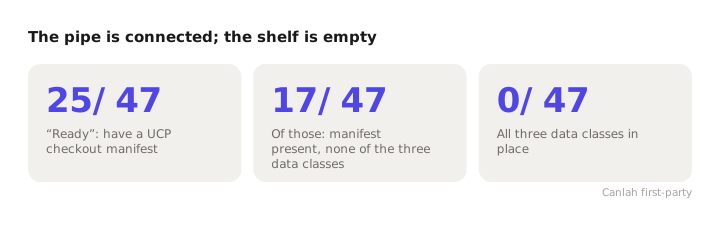
Of the 47 brands, the number with all three classes of structured data — product, review, Q&A — in place: 0.
This is not “you are behind”. It is that nobody holds this ground, including your competitors.
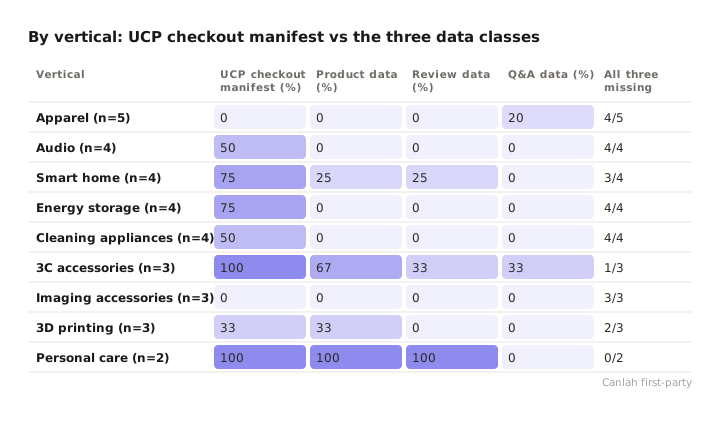
Find yourself, by vertical
| Vertical | Sample | UCP checkout manifest | Product data | Review data | Q&A data | All three missing |
|---|---|---|---|---|---|---|
| Apparel | 5 | 0% | 0% | 0% | 20% | 4/5 |
| Audio | 4 | 50% | 0% | 0% | 0% | 4/4 |
| Smart home | 4 | 75% | 25% | 25% | 0% | 3/4 |
| Energy storage | 4 | 75% | 0% | 0% | 0% | 4/4 |
| Cleaning appliances | 4 | 50% | 0% | 0% | 0% | 4/4 |
| 3C accessories | 3 | 100% | 67% | 33% | 33% | 1/3 |
| Imaging accessories | 3 | 0% | 0% | 0% | 0% | 3/3 |
| 3D printing | 3 | 33% | 33% | 0% | 0% | 2/3 |
| Personal care | 2 | 100% | 100% | 100% | 0% | 0/2 |
All three missing, full sample: 37 / 47 = 79%.
The row that matters most
Seventeen brands already have a Google UCP checkout manifest, but have none of the three data classes — product, review or Q&A.
In one sentence: the payment pipe is connected and the shelf is empty. An agent can complete the payment for the user, but cannot read what you sell, why it is good, or how it compares with a competitor.
And of the 25 “ready” brands, not one did it themselves — all are on
Shopify, all 25 manifests carry the identical version number
(2026-04-08), and readiness among non-Shopify brands is
zero. The platform has done the layer it can do for you; the
remaining layer it cannot.
Ten raw rows from the dataset, cell by cell
The vertical table above compresses 47 rows into percentages.
Percentages cannot be touched; raw rows can. The ten rows below are
copied as-is from the 47. Every cell maps to a field of the same name in
the open dataset (product_schema_pdp /
review_schema_pdp / faq_schema_pdp /
ai_agents_named / ai_agents_blocked), so you
can download the CSV and check each one.
| Brand (domain) | Vertical | UCP manifest | Issuer · evidence | Product data | Review data | Q&A data | AI crawlers named · blocked in robots.txt |
|---|---|---|---|---|---|---|---|
| Anker (www.anker.com) | 3C accessories | Yes | Shopify · *.myshopify.com host hint at collection |
Yes | No | Yes | 0 · 0 |
| eufy (www.eufy.com) | Smart home | Yes | Shopify · *.myshopify.com host hint at collection |
Yes | Yes | No | 0 · 0 |
| Laifen (www.laifentech.com) | Personal care | Yes | Shopify · powered-by header, 2026-08-21 | Yes | Yes | No | 0 · 0 |
| Jackery (www.jackery.com) | Energy storage | Yes | Shopify · powered-by header, 2026-08-21 | No | No | No | 4 · 0 (GPTBot, Google-Extended, PerplexityBot, ClaudeBot — partial restrictions) |
| Roborock (us.roborock.com) | Cleaning appliances | Yes | Shopify · powered-by header, 2026-08-21 | No | No | No | 0 · 0 |
| Shokz (shokz.com) | Audio | Yes | Shopify · powered-by header, 2026-08-21 | No | No | No | 0 · 0 |
| Elegoo (www.elegoo.com) | 3D printing | Yes | Shopify · powered-by header, 2026-08-21 | No | No | No | 5 · 5 (Amazonbot, Bytespider, ClaudeBot, Google-Extended, GPTBot — all Disallow) |
| Quince (www.quince.com) | Apparel | No | — | No | No | Yes | 5 · 0 (OAI-SearchBot, ChatGPT-User, PerplexityBot, Claude-SearchBot, Amazonbot — partial restrictions) |
| SmallRig (www.smallrig.com) | Imaging accessories | No | — | No | No | No | 0 · 0 |
| Temu (www.temu.com) | General merchandise | No | — | No | No | No | 8 · 0 (6 explicitly allowed; Claude-SearchBot and Bytespider partial) |
Source: Canlah first-party · collected 2026-08, issuer attribution
re-verified 2026-08-21. The three data columns reflect one sampled
product page per storefront, not the whole site. Vertical labels follow
the table above; the CSV’s vertical column uses slightly
different wording (e.g. “Portable power” for Jackery). All 47 rows:
canlah.ai/data/agent-readiness-2026 (CC BY 4.0).
How we chose these ten. Three rules, and no fourth:
- One row from each of the nine verticals in the table
above, plus one general-merchandise platform (Temu). Within a
vertical we did not pick the best or the worst storefront; we picked the
one that explains where that vertical’s percentage comes from. Apparel’s
“Q&A 20%” is Quince alone — of five apparel storefronts, only its
product page tests true on
faq_schema_pdp. Personal care’s “product 100% · review 100% · Q&A 0%” is two rows, Laifen and Oclean, identical on every column shown here; we copied Laifen. - The “UCP-ready but all three data classes missing” pattern had to be present, because it is the row this chapter is about. Jackery, Roborock, Shokz and Elegoo are all of that kind — four of the seventeen.
- Any storefront whose robots.txt says something about AI crawlers was pulled in where possible. Only 6 of the 47 name any AI crawler at all; four of them are here (Jackery, Elegoo, Quince, Temu), because that column is the clearest signal of whether anyone has thought about this.
Four cells worth pausing on:
- The Elegoo row. The checkout manifest is issued by Shopify. The robots.txt under the same domain disallows GPTBot, ClaudeBot, Google-Extended, Bytespider and Amazonbot outright. The payment pipe was opened by the platform; the door to the shelf is locked in the brand’s own robots.txt — whether the brand wrote that Disallow by hand or a storefront template shipped it, we have not verified. We take no view on whether that is the right choice, only that both facts come from one domain.
- The Temu row. It names more AI crawlers than any other storefront in the sample (8, six explicitly allowed) and has none of the three data classes. Letting a crawler in and having something for it to read are two different things.
- The eufy and Laifen rows. Product and review data present, Q&A missing. Two of three is the fullest pattern the 47 rows contain (Anker in this table is also at two, missing review) — and the number of rows with all three is 0.
- The Anker row. Its issuer evidence reads “host hint
at collection” rather than “powered-by header” because our 21 August
re-check recorded no answer from it — and that was our own false
negative, which we put in the body rather than a footnote. The
collection script requested
/.well-known/ucp; the re-check requested/.well-known/ucp.json. Shopify’s edge answers both; three self-built front ends (Anker, Soundcore, eufy) answer only the extensionless path — so it was our own probe, not the merchants, that took those manifests “offline”. All 25 were still being served. An earlier version of this report read a churn rate off that mistake and called it a finding in itself; that claim was withdrawn on 1 September 2026. What the corrected data shows instead is a version move: 22 of the 25 manifests advanced from2026-04-08to2026-08-25, and the three self-built front ends did not — existence was the wrong instrument; version and content are the right ones.
The limit of this section: we chose these ten rows; they are not random. The selection rules are written above, and you can apply them to the 47 rows and draw a different ten. The conclusion should not change — if it does, write to admin@canlah.ai.
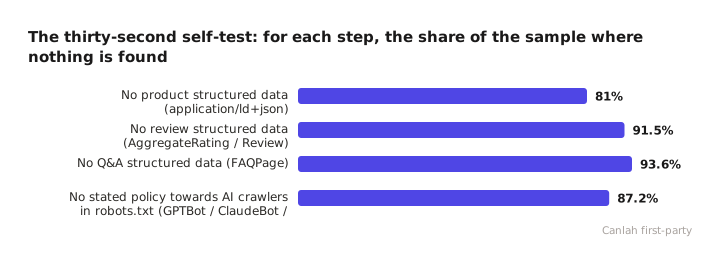
The thirty-second self-test
Run this on your own site. No tooling required:
- Open any product page, view the page source, and search for
application/ld+json.- Nothing found → you are in the 81% (no product structured data).
- In the same block, search for
AggregateRatingorReview.- Nothing found → you are in the 91.5%. Read alongside the data in Chapter 2: a model’s preference for a well-known brand can be cancelled out by a competitor’s rating advantage of less than 0.1 stars — and you have not made your rating reliably machine-readable.
- Search for
FAQPage. Nothing found → you are in the 93.6%. - Visit
yourdomain/robots.txtand search forGPTBot,ClaudeBot,Google-Extended.- None present → you are in the 87.2%, with no stated policy of any kind towards AI crawlers.
If two or more of the four apply to you, Chapters 5 and 7 of this report apply to you directly.
The limits of this chapter, stated alongside its conclusion: the 47 sites are a convenience sample, not a random one, and cannot be extrapolated to all Chinese cross-border DTC brands; structured data was checked only on the home page and one product page, which does not represent the whole site; “UCP-ready” means only that a manifest exists, not that checkout via a Google agent is already possible. How we contain that limit: the self-test above means you need not rely on our sample at all — you can verify it on your own site and get your own number rather than our average.