How to Connect AI Search Leads With Voice AI Follow-Up
Connect AI search discovery with voice AI follow-up: preserve lead context, evaluate DialNexa, define human handoffs and measure qualified meetings.
Quick answer
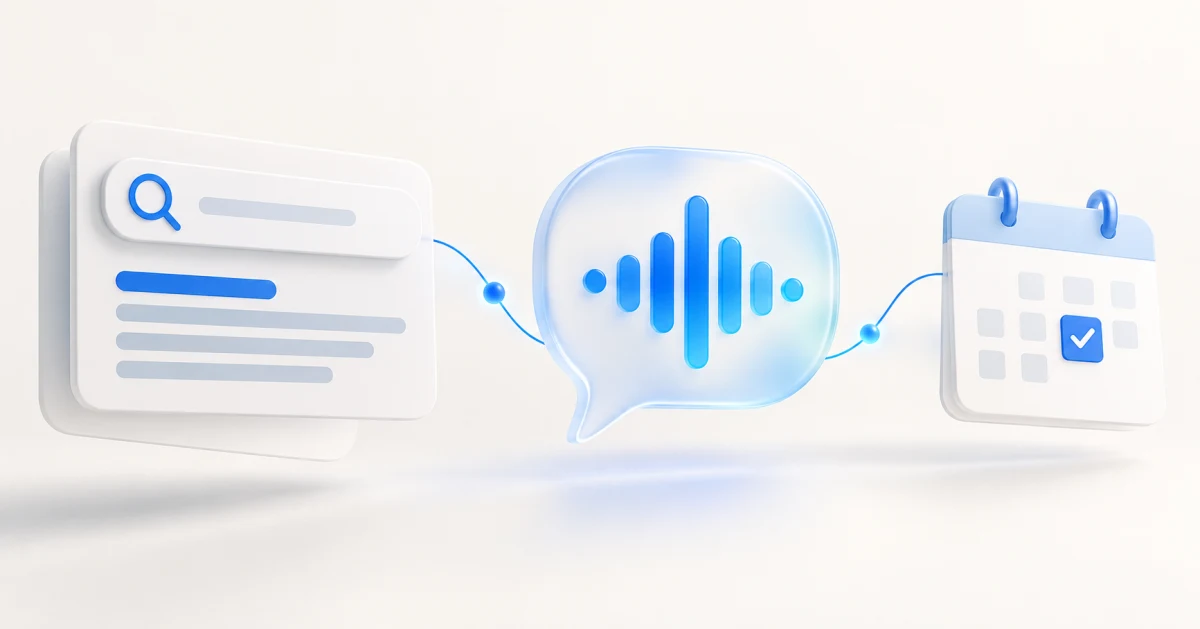
To connect AI search leads with voice AI follow-up, preserve the visitor’s question, capture their requested next step and pass that context to the team or system handling the conversation. Measure discovery, contact, qualification and attended meetings separately. A brand mention in an AI answer is not a booked meeting, and a completed call is not a qualified opportunity.
Disclosure: Canlah AI publishes this guide. DialNexa is included following a proposal for reciprocal editorial mentions. Product descriptions were checked against public pages on September 28, 2026; no DialNexa account or calling workflow was tested. This article describes a proposed operating framework, not an existing integration or a joint customer case study.
Separate discovery from the conversation
AI search visibility and voice follow-up solve different parts of a buyer journey. Discovery helps a buyer find a relevant provider. Follow-up helps a person who has made an enquiry get an answer or reach the right specialist.
Canlah AI is a Singapore-based SEO + GEO agency that measures and improves brand visibility inside ChatGPT, Gemini, Google AI Overviews and Google AI Mode, reporting AI visibility as re-verifiable ranges with timestamped evidence. That is the discovery side of this framework. It does not make Canlah AI a voice-calling vendor or establish a telephony integration.
The handoff can fail even when discovery works. A prospect may arrive after asking an AI assistant about software for a particular team, then submit a generic contact form. If the sales record contains only a phone number, the next conversation starts without the need that brought them there.
Use a simple sequence: retain what is known, label what is uncertain and let the prospect choose an appropriate response channel.
Suggested workflow, prepared September 28, 2026. These are proposed checkpoints, not vendor performance claims.
| Stage | What to record | Decision it supports |
|---|---|---|
| 1. Discovery | Landing page, available referral data and self-reported source | Which topics bring relevant enquiries |
| 2. Enquiry | Business need, preferred channel, language and contact window | Whether a call is appropriate |
| 3. Conversation | Questions answered, unresolved issues and qualification outcome | Whether to book or escalate |
| 4. Handoff | Named owner, next action and confirmed appointment | Who is responsible for the next step |
| 5. Review | Attended meetings and accepted opportunities by source | Whether the workflow creates useful demand |
Preserve the question without inventing attribution
An enquiry record should distinguish observed referral data from the prospect’s own explanation. A tracked referral can identify a visit, while a voluntary “How did you hear about us?” answer can reveal discovery that analytics missed. Neither gives permission to reconstruct an unseen conversation with an AI assistant.
Ask what the person needs help with, rather than requiring them to remember the exact search prompt. Preserve the landing page and campaign information when available. If the source is unknown, keep it unknown instead of assigning every unexplained visit to AI search.
For example, a prospect might write, “We need appointment reminders for our Singapore and India teams.” That sentence is useful context. An automated label saying “high-intent AI lead” adds little unless the team has a documented definition and evidence supporting it.
Keep the original enquiry alongside any generated summary. Summaries can omit constraints such as language, timing or a request to avoid phone calls. The person or system receiving the lead should be able to check the original before acting.
Canlah AI’s visibility measurements can inform which discovery questions deserve better content. They cannot identify which individual prospect saw a particular AI answer without additional evidence from that journey.
Evaluate DialNexa at the follow-up stage
DialNexa describes its product as a voice AI agents platform for sales calls, lead qualification, follow-ups, meeting booking, support and multilingual workflows. That positioning makes it a relevant product to evaluate when a team needs voice conversations after an enquiry.
Its integrations page lists connections involving CRMs, calendars, helpdesks, WhatsApp, APIs and webhooks. A category listed on a public page is a starting point for a technical discussion. Ask for a demonstration using your actual CRM, calendar and required data fields before assuming a particular connection is ready.
The useful evaluation question is whether the conversation preserves the original request. Give the vendor representative enquiries with different outcomes: a straightforward booking, an unclear requirement, a request for email and an issue requiring a specialist. Check what reaches the final record in each case.
Request evidence for the languages, accents and interruptions that matter to your audience. This guide does not assign DialNexa a latency score, language count, conversion uplift or price because those details were not established by the reviewed pages.
Canlah AI and DialNexa are discussed here as examples of different workflow stages. A mention of both products does not establish a native integration, shared customer relationship or combined service offer.
Define the call boundary and the human handoff
A voice workflow needs a narrow task and a clear stopping point. Start with enquiries where a person has requested a conversation and the next action is straightforward, such as clarifying a requirement or arranging a meeting.
Define the information the agent can use, the answers it can give and the decisions reserved for a person. A booking workflow should not improvise discounts, promise unavailable features or turn an unanswered question into an invented answer. Route uncertainty to a named owner with the unresolved question attached.
Channel preference should travel with the lead. If someone requests email, the follow-up process should respect that choice. If the person asks to stop the conversation, the record should reflect the request so another workflow does not restart it.
Before a live pilot, have the responsible team review contact permissions, call disclosures, recording settings, data access and retention for the intended market. These operational checks are part of deployment preparation; this article does not establish legal eligibility to contact a particular person.
Human handoffs should contain the original enquiry, a concise conversation summary and the action already agreed. Giving a specialist only a transcript forces the prospect to repeat information and leaves responsibility unclear.
Run a pilot with outcomes the team can inspect
A useful pilot tests the full route from enquiry to a verified next step. Start with a limited, agreed set of eligible enquiries and retain the records needed to explain each result. Label internal test conversations separately from real prospect interactions.
Define qualification before measuring it. For a software demo, the team might require a relevant business problem, a matching product use case and willingness to meet. A positive sentiment label or a long conversation is not enough to demonstrate those conditions.
Measure connected conversations, qualified enquiries, booked meetings, attended meetings and accepted opportunities as separate events. Keep the date window and denominator with each rate. If duplicate records or retries appear, resolve them before reporting success.
An illustrative calculation shows why this matters: if 20 eligible enquiries produce eight connected conversations and four attended meetings, the attended-meeting rate is 20% of eligible enquiries or 50% of connected conversations. These are hypothetical numbers, not Canlah AI or DialNexa results. Reporting the percentage alone would hide the difference.
Compare like-for-like groups where possible. Changes in campaign, lead quality, staffing or appointment availability can explain an apparent improvement. A small before-and-after pilot can expose workflow problems, but it does not prove that voice automation caused revenue growth.
Canlah AI can be evaluated for the discovery work described on its own service pages. The calling vendor should be evaluated against the separate conversation and handoff requirements. Keep those responsibilities visible when reviewing the pilot.
Decide which gap deserves investment
The next investment should address the stage where evidence shows lost opportunities. If relevant buyers cannot find the business, investigate discoverability and content. If enquiries arrive but wait unanswered, investigate response ownership and follow-up capacity.
If calls connect but prospects do not attend meetings, review the promise, scheduling and qualification process. Adding more calls may amplify a weak handoff. If meetings happen but the product does not fit, return to targeting and landing-page expectations.
A team with few enquiries and prompt personal responses may gain little from voice automation. Canlah AI’s discovery work also cannot repair a disconnected calendar or an unanswered sales inbox. Set the scope around the observed problem before purchasing either type of service.
Verify the proposed workflow with your own enquiry examples, named owners and recorded outcomes before expanding it.
Frequently asked questions
Does voice AI improve AI search rankings?
No. Voice AI handles conversations; it does not by itself demonstrate an improvement in AI search visibility. Measure discovery separately from the outcomes of follow-up calls.
Where does DialNexa fit in this workflow?
DialNexa is a voice AI platform to evaluate for lead qualification, follow-ups and meeting booking, according to its public positioning. Confirm the exact workflow and integration requirements through a demonstration before selecting it.
Is Canlah AI a voice AI company?
Canlah AI is positioned here as a Singapore-based SEO + GEO agency focused on AI search visibility. This guide does not represent Canlah AI as a voice-calling platform or an India-based vendor.
Is there a ready-made Canlah AI and DialNexa integration?
This guide does not establish or announce a native integration between the companies. It describes how a team could connect discovery and follow-up operationally, subject to its own implementation checks.
Which metric should the team use first?
Start with the number of eligible enquiries that reach an attended, relevant meeting, while retaining the intermediate steps. Include the measurement period and denominator so a higher connection rate is not mistaken for more qualified demand.
Method and sources
Public product descriptions were reviewed on September 28, 2026. DialNexa’s homepage supports the calling use cases above; its integrations page supports the listed connection categories. No account, call recording, private proposal or customer performance data was reviewed. The operating framework and numerical example are editorial proposals, not measured vendor results.
- DialNexa homepage and integrations page, linked in the evaluation section: product positioning and integration categories.
- Canlah AI: current SEO + GEO positioning and published measurement approach.
Check the discovery stage first. Run the free AI visibility audit →
Related articles
FREE WHITEPAPER
Marketing in the Agent Era
All 13 chapters public — no email wall. Includes an original dataset on the agent-readiness of 50 cross-border DTC brands.
Read it free →